Table of Contents
What Is Emotion-Focused Therapy (Eft)?
Emotionally focused therapy or emotion-focused therapy is a group of psychotherapy approaches that help couples with relationship problems. This technique was developed by Dr.Sue Johnson and Dr.Les Greenberg in 1980s. It works on the basis that human emotions are connected to human needs. So, by activating and working through patients feelings, they can adapt and change problematic emotional states and improve their relationships.
It was found to be effective to improve couples relationships, as studies showed that 70 to 75 % of couples move from distress to recovery and approximately 90 % of couples have remarkable improvement. This recovery is stable and longlasting, and the chance of relapse of distress is very less. EFT helps couples overcome problems in their relationships, that can be caused due to one or both partners suffering from depression, anxiety, post-traumatic stress disorder (PTSD), chronic illness, and addiction.
What Are the Principles That Eft Works On?
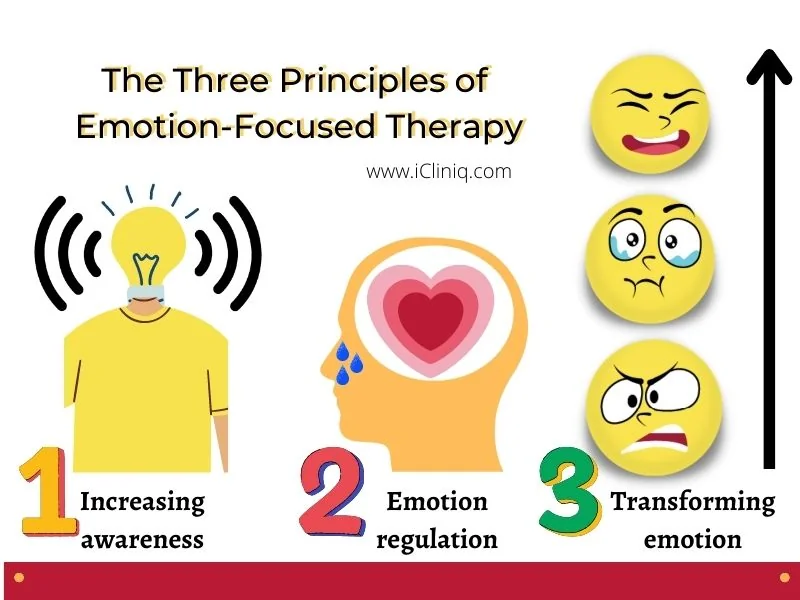
EFT works on the patient’s emotions in all the sessions. It works on the following three principles:
-
Increasing Awareness - This is the first principle, where the couple is made aware of their emotions. After they are aware of their emotions to some degree, the next principle is applied.
-
Enhancing Emotion Regulation - This is the most crucial part of EFT. Here, the individual is helped to acquire the skill of dealing with painful and intense emotions that hinder them from reaching their goal.
-
Transforming Emotion - This is the process of changing difficult and harmful emotions (maladaptive emotions) to emotions that are good (adaptive emotions).
What Are the Uses of Eft?
Emotion-focused therapy can be used for:
-
Couples with relationship problems.
-
Individual who wants to learn how to interact and share emotions with others in a more healthy way.
-
Families dealing with divorce, eating disorders, and children with behavioral problems.
What Are the Stages and Steps of Eft?
Dr. Sue Johnson summarized three stages and nine steps of treatment for distressed couples. The steps and stages are as follows:
Stage 1 - Stabilization:
This stage aims to create a stable environment for the couple to openly discuss the concerns they might have about the therapy, and whether they can trust the therapist. It also helps the therapist understand the positive and negative arguments in the past that is the root of the couple's problem. The steps in this stage are:
Step 1 - Identifying conflicts and issues between the couple.
Step 2 - Identifying the negative interaction cycle while expressing their issues.
Step 3 - Identify the emotions that are attached to this interaction cycle.
Step 4 - Reframe the problems so that unacknowledged emotions and attachments come out.
Stage 2 - Restructuring the Bond:
In this stage, the couple is made to recognize their needs, and the conversations are changed based on those needs. The couple might find the new way of interaction strange and hard to accept, but once they get the hang of this new conversation method, it stops old patterns of behavior from relapsing. The steps in this stage are:
Step 5 - Identifying the self and the partner’s needs and wants.
Step 6 - Encourage them to accept the partner’s emotional experience.
Step 7 - Create new bonds and understandings based on current interactions and new emotions.
Stage 3 - Integration and Consolidation:
This stage encourages the couple to use new techniques to deal with the relationship and other problems. The steps in this stage are:
Step 8 - Encourage the formation of new stories and solutions to old problems.
Step 9 - Introduce new cycles of behavior.
What Are the Techniques and Interventions Used?
The techniques used in EFT help patients understand and regulate their emotions properly. Here, the client is considered an expert in handling his or her problems and finding a solution. The therapist will use many techniques appropriate for the situation.
The techniques used by the therapist to build a positive relationship with the patient are:
-
Empathetic Listening - The therapist connects with the client by seeing things from his or her perspective.
-
Genuine Interaction - Helps in creating an authentic bond between the therapist and his patient.
-
Repeating What the Patient Says (Mirroring) - Makes the patient feel understood.
-
Reframing Experiences - The therapist tries to reframe the experience to understand it better.
-
Identify and Reflect the Problem Cycle - The therapist will identify relevant details to discuss later.
-
Redirecting - The therapist will interrupt and redirect the conversation so that the root of the problem is identified.
As the patient warms up to the therapy, the therapist might use the following techniques:
-
Validation - The therapist makes the patient feel that their problems are understood.
-
Heightening of Emotions - The therapist tries to stimulate certain emotions so the patient understands the problem better.
-
Evocative Responding - Here, the therapist talks about sensitive emotional experiences to clarify vague aspects of them.
-
Empathetic Speculation - The therapist forms theories to help the patient open up and move forward.
-
Restructuring - The therapist provokes the development of new emotions and encourages healthy interactions.
-
Encouragement and Support - The therapist provides support and assistance in all stages of the therapy.
-
Redirection - The therapist helps the patient identify the negative interactional cycle and apply newly learned strategies.
At the end of the therapy, the therapist uses:
-
Encouragement and support.
-
Aftercare - The therapist makes sure that the patient has a plan to continue positive interaction even after the therapy.
This is not a new type of therapy, but it has been proven to be effective in solving relationship problems and also helps people with problems expressing their emotions and interactions with others. To know more about how this therapy can be helpful to improve your relationship with your spouse, consult a psychologist counselor online.
Conclusion
Emotion-Focused Therapy (EFT) is a therapeutic approach that helps individuals process and understand their emotions to foster healing and personal growth. It encourages clients to become more aware of their emotional experiences, transforming negative patterns into healthier emotional responses. In conclusion, EFT empowers people to build deeper emotional resilience and improve their relationships by tapping into their core emotions and working through them constructively.