Table of Contents
Introduction
Besides lifestyle changes, behavioral modification and counseling are principal complementary strategies for managing obesity. They mainly focus on changing one's habits and behaviors associated with physical activity, diet, and lifestyle. Thus, people suffering from obesity are given counseling to make behavioral changes to their lifestyle activities. Counseling can help them address their hurdles or barriers to staying dedicated to physical activity and diet goals. It also motivates them to practice various strategies and promote behavioral modifications.
How Is Obesity Managed Through Behavioral Modification?
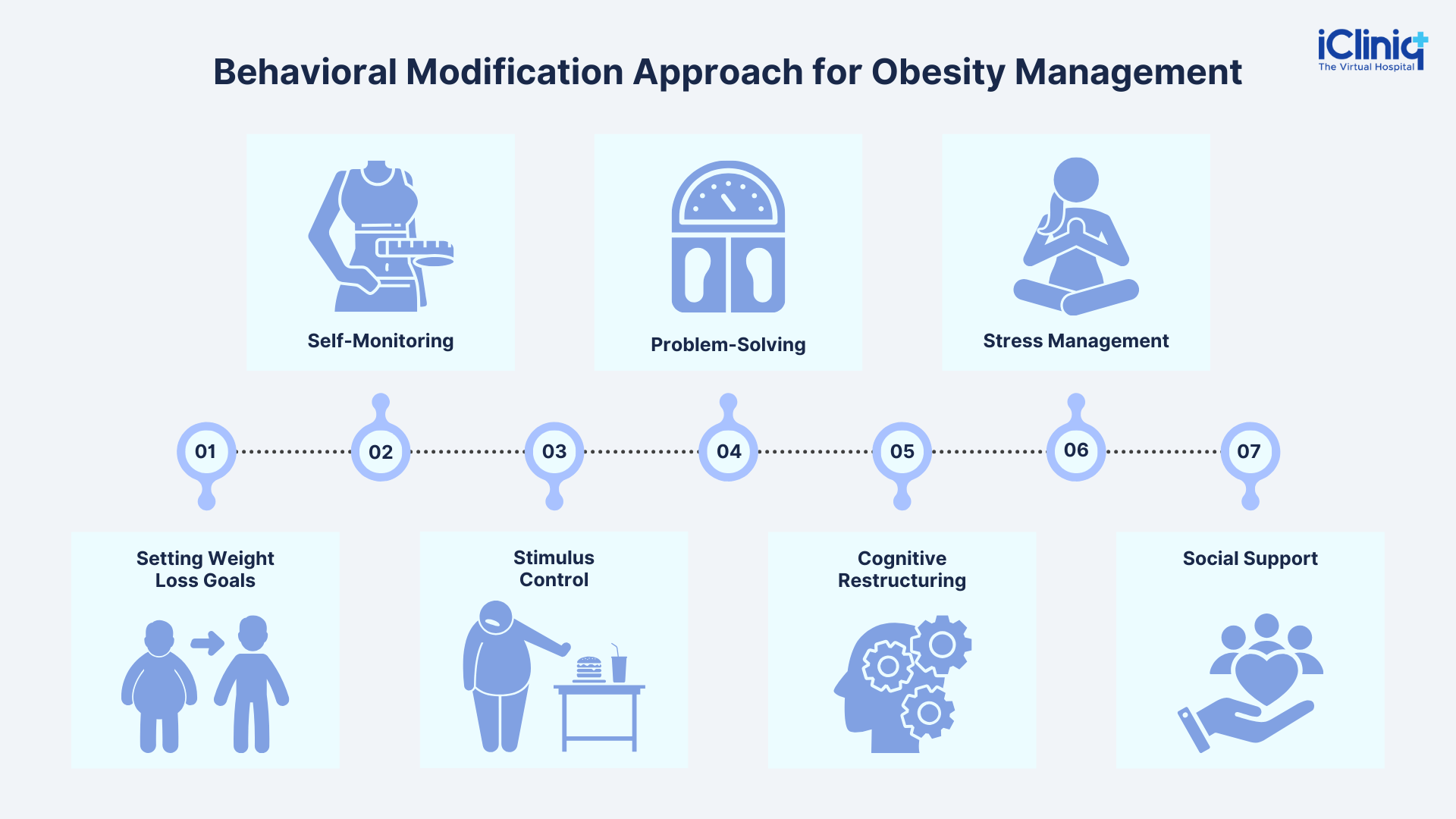
Behavioral modifications for managing obesity involve:
-
Setting Weight Loss Goals - One must set a reasonable goal for losing weight, dietary changes, and physical activity.
-
Self-Monitoring - It is an integral part of the behavioral modification strategy. One needs to assess and keep track of daily food intake, weight, and physical activity to ensure accountability and awareness. One must note down the food and drink or beverages they have consumed throughout the day and keep track of their daily physical activity. This would help to create self-awareness about lifestyle choices and the modifications required to achieve the goal.
-
Stimulus Control - It refers to keeping all unhealthy foods out of one's reach or environment and replacing them with healthy foods to reduce cravings.
-
Problem-Solving - This refers to identifying and resolving issues of not getting time and access to healthy food choices, overcoming hurdles, and practicing a healthy lifestyle.
-
Cognitive Restructuring - Focuses on eliminating unrealistic beliefs and thoughts about one's body image, weight loss, and food, thus inculcating realistic and positive thinking in one.
-
Stress Management - Involves developing coping strategies to manage emotional eating and stress, such as engaging in hobbies, using relaxation techniques, and seeking help from others.
-
Social Support - During a weight loss program, one may also seek help from various support groups, family, and friends for accountability, motivation, and encouragement.
What Are the Challenges During Behavioral Modification Therapy?
-
Instead of accepting setbacks as failures, one should see them as learning opportunities, reflect on what went wrong, and find ways to improve.
-
Also, one should understand that setbacks are a normal part of the change process. Thus, individuals should not expect perfection and be patient with themselves.
-
The process should be celebrated for what has been achieved so far, even if it is small. One must recognize that setbacks do not erase the progress one has already attained.
-
One can also contact friends, family, or a support group for guidance and encouragement. Having a support system can help one stay motivated and accountable.
-
One must be kind to oneself during setbacks and treat oneself with forgiveness and understanding, just as one would support one's friends going through a similar situation.
-
One should keep reminding oneself of why they want to change in the first place. They must reconnect with their motivations and use them as inspiration.
-
One can also change their approach if the current strategy is ineffective or not working. They must look for different methods or instead seek professional guidance to find a new approach that suits them better.
-
One should always remember that setbacks are temporary and do not define one's ability to change. Therefore, one should stay resilient and focused and keep moving forward.
What Are the Counseling Models for Managing Obesity?
Counseling plays a pivotal role in managing obesity by eliminating the barrier between the patient and the healthcare provider, such as negative attitudes and biases related to weight gain and obesity. Counseling also motivates the person to take preventative measures for the risk of chronic health conditions, such as diabetes, hypertension, and coronary heart diseases that may occur due to obesity, and improve their overall health status. However, it is also essential that healthcare providers focus on the individual needs of the patient and understand their emotions that may have an impact due to biases existing in society related to being overweight or obese. Thus, they must offer a personalized treatment plan, focusing on the patient's concerns and how they look forward to managing obesity.
Various studies have discussed several counseling models to educate individuals about weight and how to manage it effectively. Below are a few counseling models that help healthcare providers frame a weight loss management plan for their patients through practical counseling sessions.
1. Transtheoretical Model (TTM): This model talks about behavior change as a process occurring in stages - pre-contemplation, contemplation, preparation, action, and maintenance. This model believes that everyone linearly progresses through these stages. An individual may move back and forth between all these stages or get stuck in a particular stage. Thus, this model recognizes behavior change as a complex process and considers different strategies that may be effective at various stages.
2. 5 A's Model: This is the most commonly used counseling model that has proved effective in enhancing patient-doctor communication, doctors' confidence in counseling people, and motivating people to accept and implement change. The critical points of the 5 A's model are Ask, Assess, Advise, Agree, and Assist. This model is an evidence-based behavioral intervention strategy that can help improve weight management outcomes in primary care. The 5 A's model also establishes a framework for doctors or physicians to counsel patients with obesity effectively.
3. Motivational Interviewing (MI): This model is a patient-centered weight-loss counseling technique. MI helps the healthcare provider explore and resolve mixed feelings, ambivalence, or contradictions, thus increasing the likelihood of behavioral change. Motivational interviewing is mainly non-confrontational and collaborative, addressing doctors' or physicians' concerns about lecturing such ambivalent cases. This model can be helpful in weight management (weight loss and maintenance). Four principles of motivational interviewing - Engaging, Focusing, Evoking and Planning.
These principles help healthcare providers establish behavioral change by increasing intrinsic motivation, exploring and resolving ambivalence, and promoting self-efficacy in weight loss counseling.
Types of Motivational Interviewing Skills
1. FRAMES: This skill is mainly used at the beginning of the conversation during the interview process and is designed to be used on individuals who are responsive to counseling about health risks and associated behavioral modifications. FRAMES stands for Feedback, Responsibility, Advice, Menu-options, Empathy, and Self-efficacy.
2. OARS: It is a communication technique that facilitates change-talk in patients. OARS stands for Open-ended questions, Affirmations, Reflections, and Summaries.
Conclusion
Effective obesity management combines lifestyle changes, behavioral modifications, and counseling. Behavioral strategies include setting realistic goals, self-monitoring, and stress management. Counseling, addressing barriers, and providing motivation plays a vital role. Models like TTM, 5 A's, and MI offer structured approaches for personalized weight management plans. Successful weight management requires understanding individual needs, addressing biases, and creating a supportive environment, ensuring lasting change.