
Introduction:
Low back pain is a commonly reported problem. Everyone will surely experience it at some point of time in their lifetime. It is one common reason people miss work and a common reason to visit the doctor. Back pain can be uncomfortable, and as one gets older, the chances of developing back pain also increase. Though even before COVID-19, there were millions of people affected with back pain, after the working from home scenario due to COVID, the number has dramatically increased. Though the disastrous effect of this pandemic has reduced, working from home is likely to remain a new normal for several people all over the world. So what is the solution for this?
What Are the Different Causes of Simple Back Pain?
Human’s back is made of a complex structure of muscles, ligaments, bones, tendons, and disks. The compartments of the spine are cushioned with cartilage called the disks. All these parts need to function together to provide support to the body and to move around freely. Problems with any part of the spine can result in back pain.
-
Simple wear and tear from twisting and turning. When a person makes a twisting or lifting motion to carry a heavy load without bending the knees, excruciating pain may be felt immediately.
-
Strained muscles or ligaments, muscle tension, and damaged disks are caused due to lifting heavy objects or when lifting them improperly.
-
Structural problems such as ruptured disks, sciatica (sharp, shooting pain caused due to bulging or herniated disk pressing on the nerve), arthritis, or abnormal curvature of the spine.
-
Kidney stones or infections in the kidney can cause back pain.
-
Poor posture, like a hunched sitting position, can result in back pain.
-
Sleeping on a mattress that does not keep the spine straight.
-
Over-stretching.
-
Driving for a long period of time without taking breaks in between.
-
Standing or sitting for a longer period of time.
-
Fractures.
-
Tumors (cancers).
Who Is More Likely to Develop Back Pain?
The following factors can increase the risk of developing back pain:
-
Occupations that involve excessive sitting or standing.
-
Intense work or exercise when done improperly.
-
Smoking.
-
Sedentary lifestyle.
-
Older age.
-
Genetics.
-
People with certain medical conditions like arthritis, cancer, osteoporosis, etc.
How Is Back Pain Diagnosed?
Generally, back pain is diagnosed based on the symptoms reported by the patient and on physical examination. During the physical examination, the doctor presses on the muscles or parts of the spine to determine the location of the pain. But a few diagnostic tests may be recommended if the back pain seems to result following an injury if the pain is chronic, or in case the underlying cause is unknown:
-
X-Rays:
X-rays help determine the signs of arthritis or other conditions related to the bone.
-
MRI (Magnetic Resonance Imaging) and CT (Computed Tomography) Scans:
These imaging tests help determine problems related to tissues, ligaments, tendons, blood vessels, muscles, and nerves.
-
Bone Scan:
Bone scans help determine bone tumors or compression features caused due to osteoporosis.
The healthcare professional may also suggest getting a blood test if an infection is suspected.
How Is Back Pain Managed?
Home Care:
Bed rest has been shown to be counterproductive. But move as soon as the person can, and do not keep resting as this will make things worse. Avoid doing strenuous activities for a while. Applying warm compresses or cold compresses to the painful area gives relief from the pain.
When to Consult a Doctor?
-
If one is particularly worried that "their back does not seem to be right."
-
If the lower back pain does not improve within two weeks.
-
If you get an unbearable shooting pain down the legs.
-
If the back pain occurs after a huge fall one may have a fracture (broken bone).
-
If one has a fever, weight loss, and a history of cancer.
-
If one has osteoporosis and has had a history of compression fractures.
Medical Treatment:
Analgesics (painkillers) in the form of Acetaminophen (Paracetamol), NSAIDs (non-steroidal anti-inflammatory drugs) such as Ibuprofen, Meloxicam, Diclofenac, etc., can be taken individually or in combination bearing in mind their side effects. Most of these are available over the counter. As a word of caution, avoid using NSAIDs if one has stomach issues.
When to Go to the Emergency Room?
-
If the person cannot urinate or does not have bowel movements.
-
If painkillers do not respond and get a seven to ten scale pain (on a scale of ten if the pain is more than seven).
-
If a person gets a severe "shooting nerve pain" down the leg, especially while lifting their legs up. This may be a sign of sciatica (compression of the nerve down the leg) which does not go away with simple painkillers.
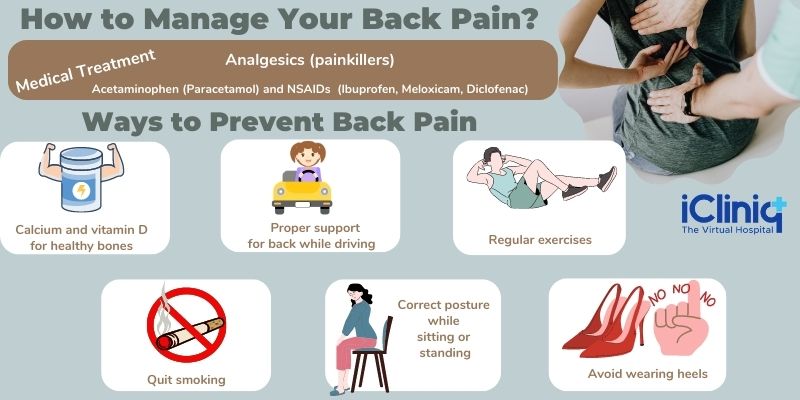
Are There Ways to Prevent Back Pain?
Here are a few ways to avoid back pain or prevent it from recurring:
1) Maintain a healthy weight by eating a nutritious, well-balanced diet. Make sure to take enough amounts of calcium and vitamin D that are required for bone health.
2) Do regular exercises such as low-impact aerobic activities that do not cause strain on the back. Strength-training exercises, yoga, and stretching exercises help ease back pain.
3) If a person smokes, try to quit smoking as smoking increases the risk of back pain.
4) Correct the posture while sitting or standing. Do not slouch or choose a seat with good lower back support, good armrests, and a swivel base. While standing, ensure that the stand upright, head facing forward with back straight. One should have a neutral pelvic position.
5) When a person is lifting objects, must try using the legs to bend and do the lifting rather than exert force on the back.
6) Using flat shoes puts less strain on the back.
7) While driving, it is important to have proper support for the back.
What Is the Outlook of Back Pain?
Back pain is a very common condition, and as people grow old they are more prone to experience back pain. For some people back pain is a chronic condition. With proper treatment, the back pain will subside. In some cases, consultation with the doctor is needed. In some cases, medication and injections are required, and in rare cases doctors recommend surgery. Daily stretches, exercise, and yoga.
Conclusion:
Back pain is one of the most common conditions people tend to come across at some point of time in their lives. With aging, you are more likely to experience back pain. In most cases, back pain usually resolves with treatment; rarely does it require a visit to the doctor. By following the prevention tips mentioned above, one can prevent another bout of back pain.
